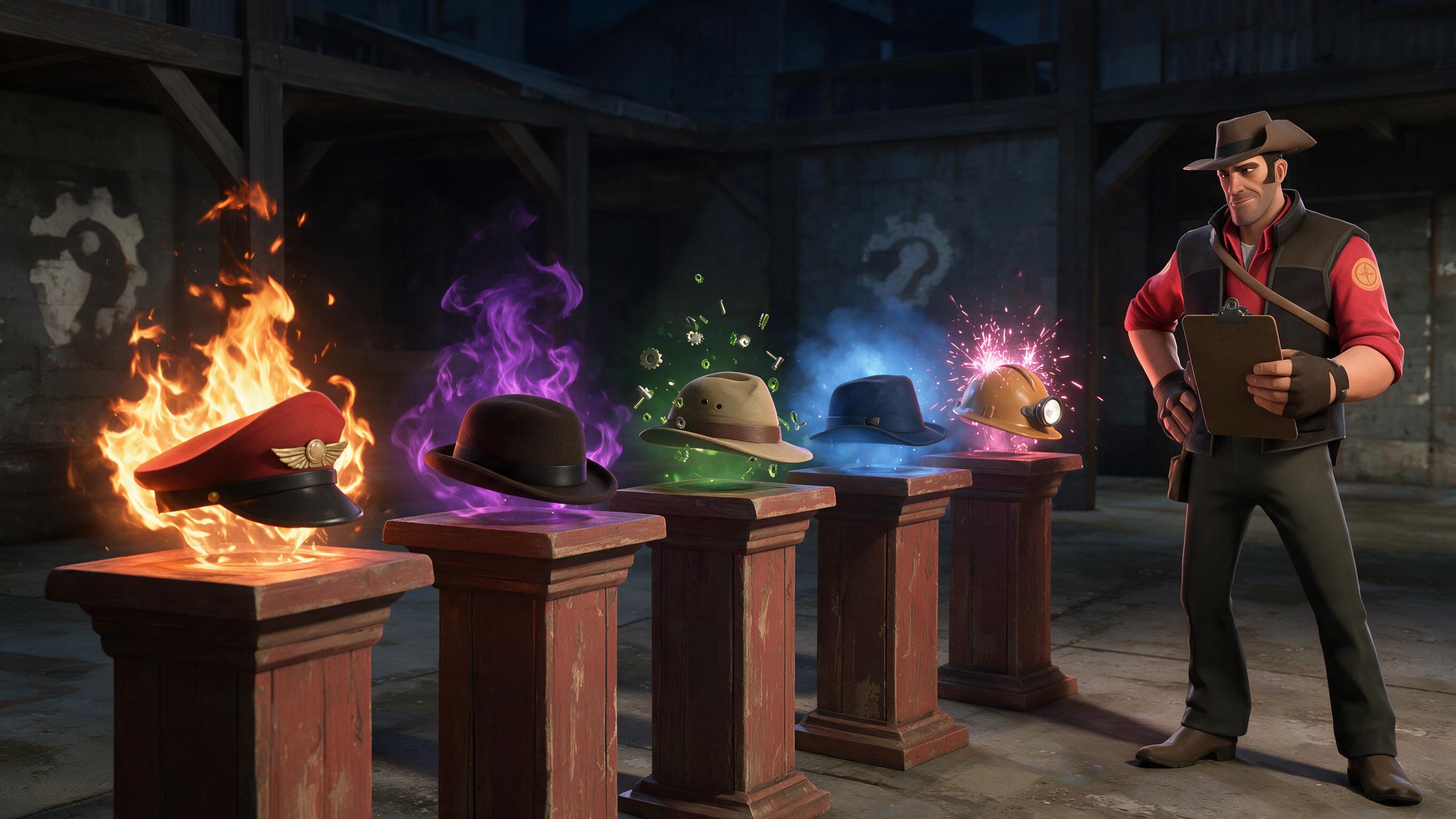
Unusual pricing looks arbitrary from the outside. It is not — it is just driven by inputs that are mostly invisible unless you know where to look.
Four of them do nearly all the work: which generation the effect came from, how many of that exact combination exist, how the particle reads on that specific hat, and how many people are currently trying to buy one.
Effects come in generations, and supply closes behind them
Unusual effects arrive in batches, overwhelmingly during Scream Fortress each October, and each batch is attached to that year’s crate or case series. When the series retires, the faucet closes permanently. Everything of that effect that will ever exist already exists.
That is why the first-generation Halloween effects still anchor the top of the market. Burning Flames, Scorching Flames and Sunbeams are not expensive because they look objectively better than everything released since — they are expensive because their supply stopped growing well over a decade ago while the number of players who want one did not.
The practical read: a brand-new effect is at its most abundant and usually its cheapest in the months right after release, and a retired effect can only get scarcer. Neither fact is a guarantee of anything, but it explains most long-run price direction.
The supply number is public. Use it
This is the single most underused fact in TF2 trading: backpack.tf will tell you exactly how many of a given hat-and-effect combination exist. Not an estimate — a count.
Before you argue about price with anyone, look it up. A combination with 400 in circulation has a real market with real comparables. A combination with 6 in circulation does not have a price at all; it has a last sale, and possibly one from 2021.
A rough tiering that survives contact with the market
| Tier | Character | Typical examples |
|---|---|---|
| Top | Gen 1, fixed supply, universally recognised | Burning Flames, Scorching Flames, Sunbeams |
| Upper | Strong colour, reads well on most hats | Hellfire, Darkblaze, Miami Nights, Cloud 9 |
| Mid | Solid, plentiful, always tradeable | Nebula, Bubbling, Stormy Storm, Kill-a-Watt |
| Entry | The affordable end, where most first unusuals live | Green Confetti, Purple Confetti, Circling TF Logo |
Treat this as a starting orientation and nothing more. The tier tells you which conversation you are in; the specific hat, the supply count and the current buy orders tell you the number.
How the particle sits on the model matters more than the tier
Effects are attached to a hat’s head position, and hats vary enormously in shape. A tall hat lifts a halo effect clear of the model where it reads beautifully. A wide or bulky hat can swallow the same effect entirely. A dense particle on a busy hat becomes visual noise.
Colour interaction does the same thing. An orange effect on a RED-painted hat disappears; the same effect on a dark hat pops. Experienced buyers have opinions about specific combinations, and those opinions are priced in long before any pricing site catches up.
The upshot for pricing: never compare across hats. Compare the same effect on the *same* hat, and only fall back to cross-hat comparables when there is genuinely no data.
Reading backpack.tf without being misled by it
The suggested price is community-voted. It is a useful reference and a poor market rate, because votes move slowly and tend to ratchet upward — nobody enjoys voting their own backpack down.
- Buy orders first. Currency actually committed by actual people. This is the strongest signal on the page.
- Completed sales second, weighted by how recent they are. Anything over six months old is background information.
- Live sell listings third, and only the ones that have been up long enough to be serious.
- Suggested price last, as a sanity check on the other three.
If the top buy order and the lowest credible ask are miles apart, you have not found a price — you have found an illiquid item. Price it accordingly and expect to wait, or read how to actually sell an unusual and decide whether waiting is what you want.
A framework you can apply in two minutes
- Look up the exact supply count for this hat and this effect.
- Pull the top buy order and the three most recent completed sales.
- Adjust for paint, spells and craft number — each is a separate premium, not a vague “extras” bonus.
- Adjust for how the effect reads on this particular model.
- Set a band, not a number: your ask, your realistic pure price, and your walk-away floor.
Run the same five steps on every item and your estimates get measurably better within a couple of months, because you start accumulating your own comparables instead of borrowing everyone else’s. That private dataset is the actual edge — not any single price you look up.
Common questions
- Which TF2 unusual effects are the most valuable?
- The first-generation Halloween effects — Burning Flames, Scorching Flames and Sunbeams — sit at the top of most price tiers, because their supply stopped growing over a decade ago while demand did not. The specific hat they are attached to still swings the number heavily.
- How can I see how many of an unusual exist?
- backpack.tf publishes exact circulation counts per hat-and-effect combination. Check it before negotiating: a combination with hundreds in circulation has real comparables, while one with a handful has only a last known sale.
- Does the hat or the effect matter more for price?
- Both, but they are not interchangeable. The hat determines whether a buyer is interested at all; the effect determines what they will pay once they are. A top-tier effect on an unpopular hat routinely sells for less than a mid-tier effect on a popular one.