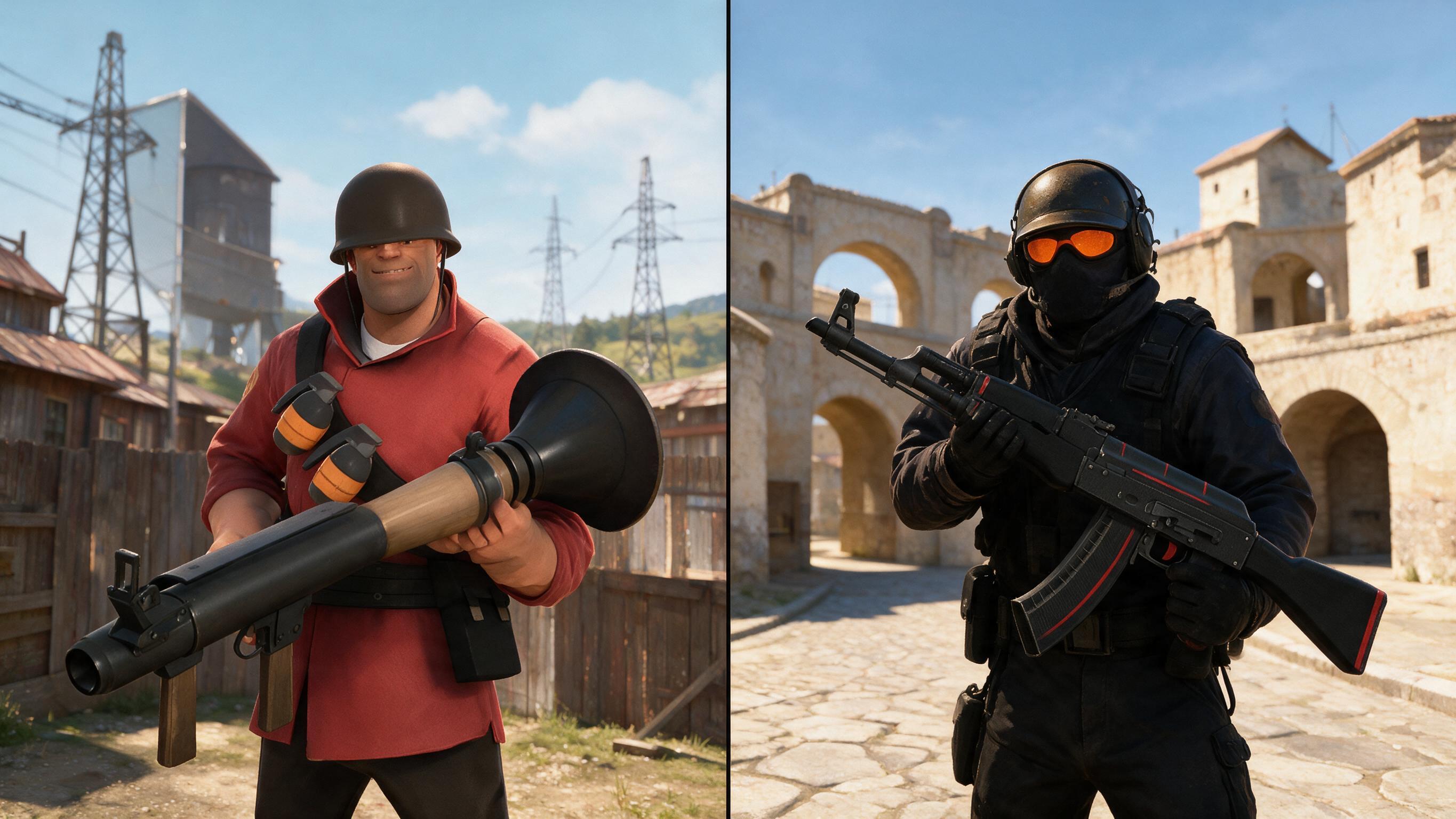
The instincts transfer better than you would think. Price-check before you talk, read the confirmation screen, never trust the cheapest listing — all of that is the same game.
What does not transfer is the mental model. CS2 prices in dollars, not metal; it has a hidden decimal attached to every item; and it moves fast enough that the leisurely TF2 negotiation is mostly gone.
There is no currency ladder — everything is dollars
The first adjustment is the largest. CS2 has no scrap, no refined and no key-as-unit-of-account. Prices are quoted in real money and anchored to the Steam Community Market, which is deep enough to act as a genuine reference price for almost everything.
That kills an entire skill you spent time building. There is no conversion arbitrage, no “paying in metal because keys are pricey this month”, no rounding a trade with a craft weapon. There is a price, and the argument is about whether it is the right one.
It also mostly kills overpay culture. In TF2, a seller taking three items instead of pure is routine. In CS2, the near-universal expectation is cash-equivalent value, because a reliable cash-equivalent number exists for almost every item.
The bits that map cleanly
| TF2 | CS2 | Notes |
|---|---|---|
| Strange quality | StatTrak™ | Counts kills; adds a modest premium on popular weapons |
| Unusual effect | Knife / glove rarity | The prestige tier everyone is actually saving for |
| Crate + key | Case + key | Same lottery, same terrible expected value |
| Killstreak sheen | Sticker craft | Cosmetic layering that can add or waste real value |
| Paint | Nothing | No direct equivalent |
| Nothing | Souvenir | Tournament-drop variant with no TF2 counterpart |
Stickers deserve a warning of their own. Applying a sticker is permanent, scraping it destroys it, and a valuable sticker on a cheap gun is the CS2 version of putting an expensive Strange Part on a two-ref Scattergun — a mistake we covered in the Strange weapons guide and which works identically here.
Trade locks and liquidity change how you behave
Items bought on the Steam Community Market carry a trade lock — commonly around a week — before they can move again. In TF2 you mostly worry about your counterparty’s escrow status; in CS2 you also have to track your own inventory’s availability. Plan around it or you will agree to a trade you cannot complete.
Liquidity is the other big behavioural shift. CS2’s market is enormously deeper than TF2’s. Spreads are tighter, bots are everywhere, and prices update continuously. The upside is that you can nearly always sell. The downside is that the patient, chatty TF2 negotiation — where you can talk someone from 20 keys to 17 over an evening — barely exists. The price is the price, and the next seller is one click away.
TF2 rewards knowing the item better than the person you are trading with. CS2 rewards knowing the number faster than they do.
What carries over unchanged
- Fee arithmetic. Steam still takes roughly 15% and still pays in locked wallet funds. The compounding maths in where your money actually goes applies identically.
- Scam awareness. API-key hijacks, fake login windows and QR phishing target your Steam account, not your game. Everything in the scams that still work is unchanged.
- Confirmation discipline. Read the other side’s items on the mobile screen. Quickswitching a float or a StatTrak is exactly as easy as quickswitching an unusual effect.
- Price-check first, talk second. Universal.
If you already trade TF2 competently you are most of the way there. Learn float, learn which patterns matter, respect the trade lock, and accept that the negotiation is shorter. The rest is the same discipline applied to a bigger, faster market.
Common questions
- What is float value in CS2?
- A hidden number between 0 and 1, fixed when the skin is generated, that determines how worn it appears and which wear tier it falls into. Within a tier, lower floats generally command a premium, so two Factory New copies of the same skin can be priced very differently.
- Is StatTrak the same as Strange in TF2?
- Functionally yes — both count kills on the weapon. StatTrak tends to carry a more consistent premium on popular CS2 weapons than Strange does on most TF2 ones, but neither is where the serious value sits.
- How long is the CS2 trade lock?
- Items bought on the Steam Community Market are typically locked from trading for about a week. Plan your sales around it, since the lock applies to your own inventory rather than to your counterparty.
- Is CS2 trading easier than TF2 trading?
- It is faster and more liquid, which makes selling easier and negotiating harder. TF2 rewards deep item knowledge and patient bargaining; CS2 rewards reacting quickly to a price that is already public.